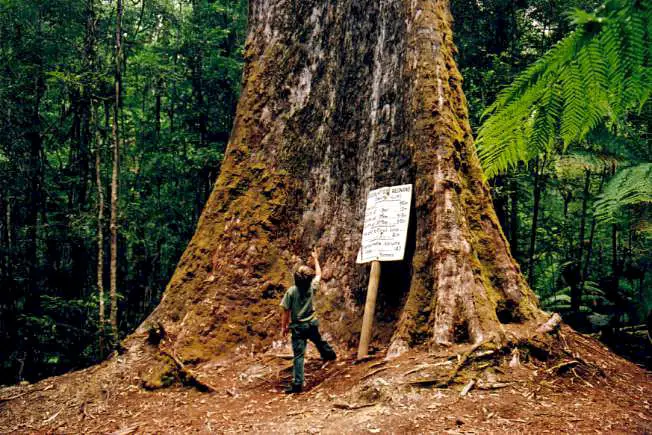
- Scientific Name: Petersianthus quadrialatus
- Morphology: The leaves are simple, spirally arranged, obovate, 10–16 cm long and 5–8 cm wide. The base is acutely acuminate, long cuneate, apexrounded caudate. Glossy and dark green, the petioles are short with short soft hairs. Fruits are in capsule form in flat circular outline containing four large winged seeds.
- Growth and Size: Natural regeneration is very scarce. Seedlings can be found as far as 200 m from mother trees, especially between buttresses. Height increment in a 2-year-old plantation was 0.7 – 2.9 m and diameter increment is 0.6 – 3.8 cm. Petersianthus quadrialatus trees coppice easily.
- Largest Tree: Currently known tallest Petersianthus quadrialatus growing near national highway, in the outskirts of San Francisco town, Alegria municipality in the northeastern part of Mindanaoisland. The tree is 65 metres (213 ft) meters high, 360 centimetres (140 in) in diameter, and estimated to be ~ 300 years old.
- Distribution: Petersianthus quadrialatus endemic to the part of the southeastern Philippines – Mindanao, Leyte, Samar, Negros, Masbate and surrounding smaller islands.
- Uses: Leaves are medicinal especially in treating skin rashes. Seeds are edible and taste like groundnut. Because its wood is hard and difficult to cut and is as strong as molave (Vitex parviflora), its highly preferred for heavy construction such as bridges, beams, joists, poles, wood piles of wharves and piers, veneer, and plywood, also for door faces and door components like jambs, stops and casing.
AERIAL FOOTAGE OF THE TOOG TREE IN AGUSAN DEL SUR ( CREDITS TO THE OWNER OF THIS VIDEO)
 Tree's the Lungs of the World